Wednesday, October 25, 2017

Mrs. Harker; a quiet influence on my childhood


From time to time, I would say things to Sharon such as: “Mrs. Harker made wonderful ginger biscuits” or “Mrs. Harker gave me some cool things that her brother brought back from Nigeria” or “Mrs. Harker and I walked over the moors to Ilkley for my birthday”.  Not unreasonably, Sharon would then ask me about Mrs. Harker and I did not have all the answers. This account is an attempt to provide some of these answers.


Mrs. Harker (late 1950s). Taken on the lawn in her back garden.

Mrs. Harker was a neighbour who lived close-by at 31, Unity Street.  I spent many hours in her company as a child but really knew very little about her. Until now.  When I started my research, I located a remarkable online transcript of an interview with her that was conducted in the late 1960s as part of a study “The Edwardians; Family Life and Work Experience Before 1918”. This project was created by Paul Thompson, Research Professor of Sociology at the University of Essex and is now archived at the University. It, together with sites such as Ancestry and FindMyPast enabled me to compile something of Mrs. Harker’s story. 

Mrs. Harker was born Frances Thornborough in 1895 in Casterton, just across the River Lune from Kirkby Lonsdale in Westmorland. Her parents were James and Margaret (née Nicholson), also from Kirkby Lonsdale. At the time they were married, Margaret was a cook at Casterton Hall (note: there are no less than three buildings that lay claim to this name). Frances attended Casterton National School, founded in 1823 by the Reverend Carus Wilson.


 Casterton National School which Frances Thornborough attended before the family’s move to Riddlesden when she was about six years old.

James was employed as a gardener (as was his father, Edward) but also had a less-reputable source of income.

Apart from his gardening? Well he'd go poaching. Everybody in the village poached you see, except the parson and the policeman. The River Lune was at the bottom of the wood. And if the bobby saw a man coming out of the wood with a sack on his back, he'd just say, Goodnight Jim. Next day, he would call at mother's to see how the babies were; there was always one in the cradle. And there'd be his little paper parcel on the table. He said nothing, mother said nothing. But he picked up the parcel and when he got home, it was his piece of salmon. That's how they did it in Casterton. And the parson knew. And he also used to call to enquire about the babies. And he got tomorrow's dinner. There were great goings-on in that little village. I wish I lived there now. No, that would be the only other job he did, besides his gardening, just his bit of poaching”.

By 1901, the Thornborough family had moved to Morton Banks (Riddlesden), near Keighley. James Thornborough first worked as a gardener for James Clarkson at West Riddlesden Hall, a fine 17th century manor house near the Leeds-Liverpool canal. Clarkson was a solicitor at a well-known Keighley law firm. James was later employed by the Keighley Rural District Council in the road maintenance department.


West Riddlesden Hall circa 1920 where James Thornborough worked as a gardener

Frances had two elder brothers, Isaac Edward and John (Jack), a younger brother Henry (Harry) and a younger sister, Annie Elizabeth. The 1911 census shows Isaac and John as solicitors’ clerks (with Clarkson’s firm), Frances as a blouse maker and Henry as a doffer (one who removes bobbins holding spun fiber from a wool spinning frame). Apparently, James and Margaret had a total of seven children but two had died in infancy. The youngest child, Willie, died when he was three but nothing is known about the other.


A child-doffer in the Yorkshire textile industry

Upon moving to Riddlesden, the Thornborough family lived in a decent-sized cottage (converted from two smaller ones) near the Hall. Around 1905, they moved to 31, Unity Street though goodness knows how they all fit into the two-bed terraced house.


Riddlesden taken from Thwaites Brow (2014). The steep Unity Street can be seen just right of center.

Frances had a very happy childhood though life was not always easy but that was true for many families in those days. The weekly washing was done in a boiler that had a burner underneath it. Margaret made all the children’s’ clothes. and knitted the boys’ socks. James bought a last and bought already-cut leather to sole the children’s shoes. Bath-time would be in a tub in front of the fire: the cleanest got in first, the dirtiest was last. 


Unity Street (2014).  Number 31 was in the middle of this row of terraced houses on a nerve-challenging cobbled street.

The Thornboroughs apparently ate well. “Liver in those days was about tuppence a pound: liver and onions with dumplings in. And roast potatoes because they all went in the oven you hadn't to bother with a pan. And then a rice pudding after that. Another day it would be a meat and potato pie. And the crust would an inch thick; beautiful flaky suet crust.  But there was one thing that puzzled me for many years. Oh, I think I was grown up before I knew the reason. It was a great big pie like that, she had two enamel dishes, one held a quart of milk, that she could make a rice pudding you see and the other held the meat. And one corner always had a cross in it. I never knew until I was grown up that this corner of crust with the cross on it was dad's. There was more meat in it.  Our joint was always cooked on Sundays. Mother was a good cook, we had glorious meals.”

Margaret must have been an avid reader: Frances recounted on several occasions how her mother’s choice for relaxation was to disappear with her book.  James seems to have been a good husband and father.  He lit the fire every morning and have a good blaze going by the time his wife got down.  “He would have done anything. Any mortal thing we'd asked him. He would have - when we were tiny he always took us out. And as I tell you he went to church every Sunday morning and in due time shepherded five children in. He would have laid his soul open for us”.

As a child, Isaac had been diagnosed with diseased vertebrae but must have recovered as he went to Nigeria at some point, returning in 1914. However, he died two years later, possibly from diabetes. During the Great War, Jack served in the Duke of Wellington’s West Riding Regiment and was killed in action in 1916. He was buried in the Lonsdale military cemetery in France.  1916 was clearly a terrible year for the family. 


Above: Jack Thornborough.   Below: the Lonsdale military cemetery where he is buried


Harry served in the Scots Guards in the Great War, being discharged in 1919.  In 1915, when he was 18, Harry married Sarah Catherine Briggs who was 12 years his senior. In 1954, he married again, to Dorothy Charnley who was 28 years younger than he.  There is some anecdotal evidence (the 1939 register) to suggest that Harry did have at least one child. During our acquaintance, Frances never spoke of Harry or his family.

Frances left school at 13 and for two years stayed with aunts back in Kirby Lonsdale while she learned dressmaking. She then went to work at a shop on North Street in Keighley. Frances was courting a boy around 1916 but he went to the Great War and was killed in the following year.  She remained close friends with his sister and became godmother to her daughter.

In 1938, the then 43-year-old Frances married one Joseph Harker. Joseph was born in Lodge Green, Melbecks in Swaledale in the North Riding of Yorkshire, son of James Harker, a lead miner.  Joseph’s mother was Alice Bell. In the early 1880s, the Harker family moved to Keighley. Alice died shortly thereafter, when Joseph was only 8 and his father subsequently remarried, to Sarah Ann Greenwood. By the time he was only 12, Joseph was working as a worsted spinner in Keighley, as was his 10-year-old younger brother.  Some researchers have estimated that in those days, children under 13 comprised up to 20% of the work force in the wool mills. Sadly, his father, James ended up as a resident of the Pauper Lunatic Asylum in Menston where he died in 1913.

In 1903, Joseph Harker, by then a colour matcher in a wool mill, married Susan Smith of Keighley, with whom he had two children, Alice Muriel and Eric Smith.  Susan died in 1932.  His later marriage to Frances Thornborough was quite short-lived, as he died only four years later.  They had no children.

Frances referred to Joseph and his then-wife when reminiscing about entertainment options with her friends during the War years. “There was only about the pictures that you could go to for sixpence. You got a beautiful seat for sixpence with plush tip-ups. And then you could go to the Temperance Hall every Monday evening when the Glee Union used to give a concert there. It was a glorious all male concert.  In due time, many, many years after, I married the conductor of the Glee Union. Not that me going to the sixpenny concerts led up to it: his wife was alive and kicking in those days”.

In her later years, Frances Harker became a genteel member of the Riddlesden community. She was Chairman and President of the local Conservative party and was a regular member of the congregation at St. Mary’s Church. Frances died in Riddlesden in 1980. Probate listed her assets as £8977, most of which was presumably made up by the value of her house.


St Mary’s Church, Riddlesden where Mrs. Harker was a regular member of the congregation

I do not know how the relationship between Mrs. Harker and the Hudson family became established. My elder brother remembers Frances’ mother, Margaret, from the early 1940s who continued to live in Unity Street after her husband died. Throughout my childhood, I clearly remember spending many hours with Mrs. Harker. I would just go over and knock on the door at Number 31.  She was a good cook and certainly I enjoyed the afore-mentioned ginger biscuits on occasions.  I remember the house very well, including the attic where her brother’s Nigerian artifacts were stored and her cellar where her delicious elderflower wine was kept. On one birthday occasion, she and a friend of hers walked with me over the moors to Ilkley and we then went for afternoon tea before taking the bus back. That would have been an all-day affair. On occasions, her sister, Anne would come to visit. Miss Thornborough was considered exotic by the village.  She lived in London, wore heavy make-up, had horn-rimmed glasses and smoked cigarettes using a cigarette-holder. Mrs. Harker gave me various artifacts that her brother brought back from Nigeria and also, his stamp album that today probably would have been quite valuable. These gifts gave rise to my own father’s somewhat unjust comment “Hasn’t she got a dustbin?”


A horn from an Ibex-like creature that Mrs. Harker’s brother brought back from his African assignment.  Last of the artifacts that she gave to me.

Sadly, my mother and Mrs. Harker had a falling out in my teen years, probably over a misunderstanding. As I grew older, our relationship also faded. After I left for University in 1966, I have few memories of going to see her. With hindsight, that is a matter of some regret.


Monday, December 19, 2016

Musandam: the isolated land of the Shihuh


It was about 4 am when the camp steward woke me with the customary canned orange juice. And then to the mess tent where the seismic party’s surveyor, Ron Townsend was swaddled in a woolen blanket. The night air in northern Ras al Khaimah can be surprisingly chilly. Back in 1969, Radio Luxemburg could still be heard from 4000 miles away and the disc jockeys made a bizarre accompaniment to our breakfast.  Ron mumbled that he hoped the morning would not bring a repeat of his experience of the day before when the Shihuh tribesmen from the mountains had taken pot-shots at him as he traversed their territory. I had no clue who these mysterious Shihuh were but years later I found out that my father had experienced similar encounters in the early 1950s when on geological field parties in Oman with the Iraq Petroleum Company. Who were these mysterious Shihuh and why are they so belligerent?


Map of Oman and the Musandam peninsula (File image)

The Shihuh are a “tribe” who inhabit the Hagar mountain range which dominates the Musandam landscape of northernmost Oman and which extends west into Ras al Khaimah.  To the north, the Hagar plunges dramatically into the sea where the coast is characterized by long “kawrs” or inlets. Geologically, the peninsula consists of a vast outcrop of Mesozoic-age carbonate rocks situated on the Arabian tectonic plate. As this plate continues on its collision course with the Eurasian plate to the northeast, the northern tip of Musandam is subsiding at the extraordinarily fast rate of 6 - 8 mm per year. It is this subsidence, combined with post-glacial sea-level rises, that produces the drowned fjord-like coastline.


A classic Musandam view of the kawr coastline (file photograph)

The earliest archaeological artifacts found in the area have been Palaeolithic tools from Omani caves. Tombs which have included both human remains and pottery dating back to the Bronze Age have been found in both Oman and the UAE.  The Sumerians from Mesopotamia, the ancient Greeks, Turks and Persians have all passed though the region until the Portuguese established themselves in Oman, including Musandam, by the mid-1500s.  Early Portuguese maps of the area do show a settlement in the area and the Persian fort in Khasab (which was, and is, Musandam’s largest town) was rebuilt by the Portuguese. They were eventually driven out by Imam Sultan Bin Saifthe in 1650.  By now, the British were expanding their sphere of influence in Arabia and the special relationship between Oman and the British dates from 1798 when the first treaty of “friendship and protection” was signed.


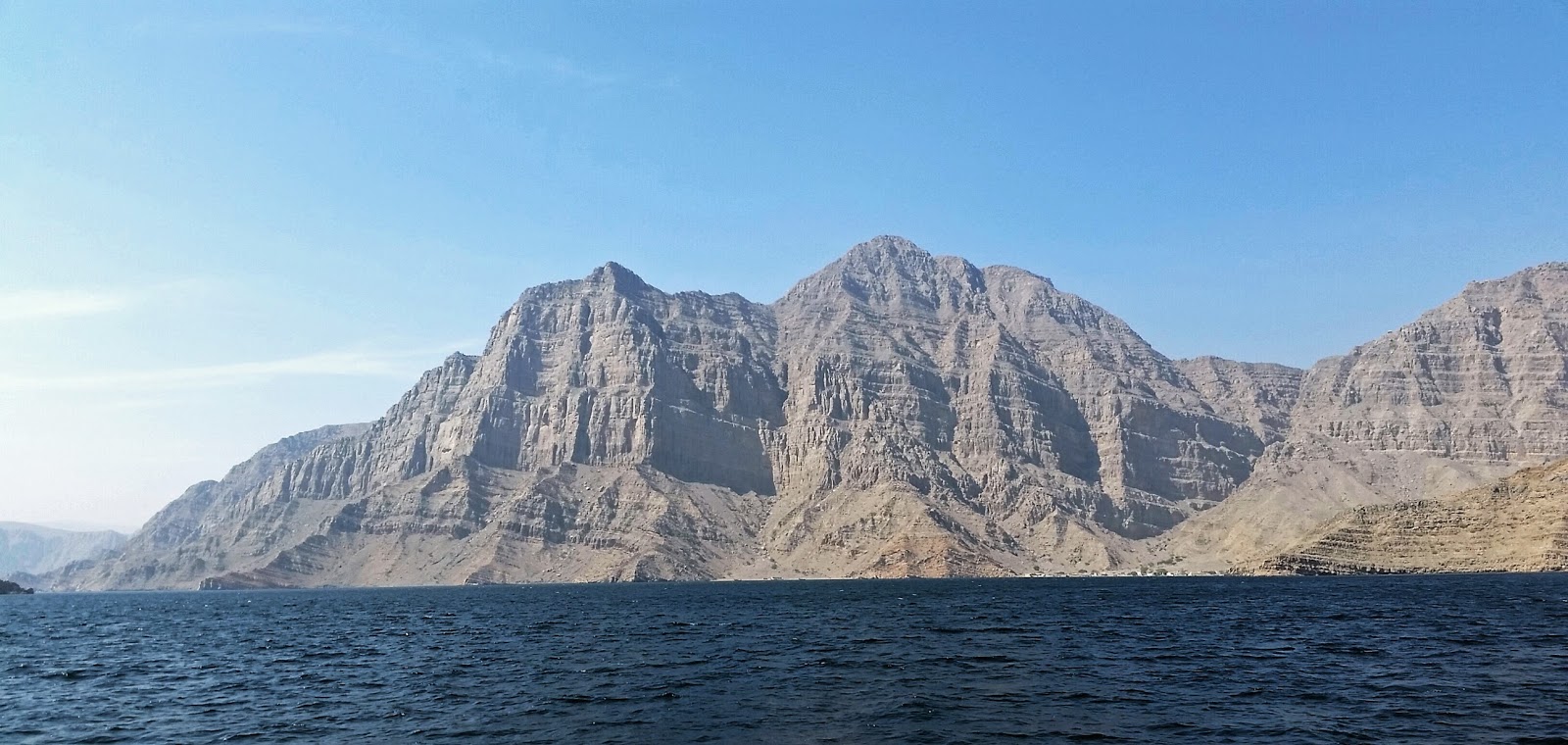
 The impenetrable Hagar mountains from the sea (William Hudson, 2016)

Oman lay on the great trading routes between India and Africa.  The magnificent wooden dhows with their large triangular sails crossed from one continent to the other and it is no accident that Mombasa, Zanzibar, Mogadishu, Aden and Muscat all share remarkable similarities.  Some of these ships undoubtedly stopped in Khasab en route.  


A dhow in the waters of the Trucial Coast (IPC expedition photo from the 1950s)


A dhow under construction in Ras al Kahimah (William Hudson, 1969)

By the 19th century, the Omani empire extended from Zanzibar to Persia and was very actively involved in the East African slave trade. Like any trading people, Omanis are inevitably a genetic admixture and African blood is undoubtedly part of the mix.


Extent of the Omani Empire in the mid-19th century (GeoCurrents file image)

The isolation of the Hagar mountains perhaps results in a less-complicated genetic history. Nearly all of Musandam’s indigenous people are Shihuh, generally considered to be early migrants from the highlands of Yemen, probably intermingled with Persian blood. Musandam is an isolated, harsh environment where temperatures can reach over 120 Fahrenheit in the summer. Most of the peninsula was historically only accessible from the sea and the Shihuh are historically very hostile to outsiders though less so since first the graded tracks into the mountains were built in 1981. 

The northernmost town is Kumzar where densely-packed houses sit wedged together at the base of a steep gorge. Here, the local Shihuh population speak a unique amalgam of Arabic and Farsi; Iran is only a short 35 miles across the Straits of Hormuz.  Most of the vocabulary and grammar is Persian, although a large number of Arabic words exist in the everyday speech. Today, members of the younger generation tend to learn Arabic instead of the language of their parents. The days of their unique dialect are probably numbered.

The Shihuh survive on fishing and subsistence agriculture, primarily raising goats and growing barley and dates. They are semi-nomadic: living in barasti huts on the coast and in stone dwellings (bayt al qufl) in the mountains, migrating between the two according to the seasons. 


A mountain bayt al qufl (William Hudson, 2016)

Their farming depends on run-off irrigation from unreliable rains which is channeled into irrigation systems, some of which date back to the Iron Age. 


Cultivation in a high plain in the Hagar mountains (William Hudson, 2016)

The bayt al qufl usually contain ceramic storage jars used for storing oil, grain and water. This unglazed, coarse earthenware is known as Julfar Ware and has been dated back to the 14th century. Several kiln sites have been discovered, the best known of which is from the Shimal area of northern Ras al-Khaimah.  Julfar Ware was still being made, with minimal changes, until the 1970s. 


Julfar Ware in an bayt al qufl (William Hudson, 2016)

The Shihuh also exhibit a culture of rock art (etched petroglyphs). Some date back to the 4th millennium BC while others are very recent. Animals that have been depicted include ibex, leopards, ostriches, horses and camels.


Shihuh petroglyphs high in the mountains of Musandam (William Hudson, 2016)

In much of the Gulf Region, the ornate, sheathed knife known as a khanja is ubiquitous and very ornate ones often indicate the high social status of the owner. 


An Omani kahnjar 
("Swords and Antique Weapons" file photograph)


A Gulf-state Sheik's son, wearing a traditional khanjar 
(IPC expedition photo from the 1950s)

The Shihuh, however, carry a jerz, the long-handled axe that is unique to Musandam. The head is small (2-3 inches) and can either be very simple or might be decorated with intricate inlay.  Prototypes date back thousands of years but predictably, many of those available today are imported from India.


A Shihuh jerz (thesaleroom.com file photograph)

Fiercely protecting their isolation and independence, a Shihuh sheikh wrote to the British Representative in 1930: “We will declare Jihad and kill whosoever arrives in our quarter and will allow none of them to return”.  Both Ron Townsend and my father were, perhaps, lucky to have made it out unscathed.


The enigmatic Musandam peninsular from space
(NASA file photograph) 

BIBLIOGRAPHY

Costa, Paolo M. Musandam: Architecture and Material Culture of a Little Known Region of Oman. Immel Publishing, London 1991.
Dostal, Walter. The Shihuh of Northern Oman. In “The Geographical Journal”, Vol 138, 1972.
Falcon, N. L.. The Musandam Expedition 1971-1972.  In “The Geographical Journal”, Vol 139, 1973.
Feulner, GaryGeological Overview in The Emirates, a Natural History. Trident Press, 2006
Fossati, Angelo EugenioRock Art in Jebel Akhdar, Oman. In “TRACCE Online Rock Art Bulletin”, Milan, 2015.
Morton, Michael Qentin. In the Heart of the Desert. Green Mountain Press, Aylesford 2006.
Morton, Michael Qentin. Keepers of the Golden Shore. A History of the United Arab Emirates. Reaktion Books, London 2016.
Rothaus, Richard. The Musandam Peninsula Oman Expedition. In “The Minnesota Archaeologist”, Vol 70, 2011
Western, Rob. The Southern Ruus al Jibal – an Introduction to its People and Natural History. Bulletin 25, Emirates Natural History Group, 1985.


Saturday, May 28, 2016

Appalachian Stack Cake - by that well-known Yorkshire authority

 I was introduced to Appalachian Apple Stack Cake when Sharon was compiling her family cook book.


Stack cakes are rooted in mountain culture, loved by the early settlers.  Perhaps having origins in European tortes, both Kentucky and Tennessee now lay claim to be the source of the first stack cakes.  However, they could not have been common until the mid-19th century when wheat flour became widely available.

The cake is somewhat of an enigma.  It is relatively expensive to make and is very time-intensive: hardly consistent with the economically-deprived area of Appalachia where life could undoubtedly be very hard. Not surprisingly, stack cakes were usually reserved for special occasions: weddings, Thanksgiving and Christmas.  Their use as a wedding cake has an interesting twist: friends and family supposedly brought a layer each for the cake and the bride's family then spread the apple filling on the layers as they arrived.  Some are skeptical about this traditional story as a stack cake should ideally sit and “cure” for at least two days. The moisture from the apples then softens the layers, making the cake even more delicious.


Some of the ingredients are critical: sorghum molasses in the cake mixture and spices (cinnamon, ginger and nutmeg) in the apple filling.  Sorghum molasses were prepared each year.  The cane was crushed and pressed to release the juice, which was then cooked until it reduced to a dark, sweet, syrup. Traditionally, the cake layers would be baked individually in a cast-iron skillet over a cooking fire, stacking and filling as you go.

Carefully dried, sulfur-free apples are essential for the filling and most recipes spurn the use of apple sauce as a substitute.  Pieces of apples were threaded onto strings and hung in the rafters or strewn onto quilts spread out under the autumn sky. Properly-dried apples are sweet, pliant, and flavorful. To make the stack-cake filling, the dried apples are gently cooked until they collapse into a thick stew.

The recipes inevitably have local variations and the final cake can vary significantly.  Some cakes look undoubtedly “cake-like” whereas others look like a stack of relatively stiff cookie-like layers.  Either way, to accommodate the typical eight layers (and as many as twelve), each needed to be pressed very flat.


Sunday, May 17, 2015

The Definitive Yorkshire Parkin


The History

Parkin is a soft, sticky gingerbread cake made with oatmeal and treacle. It originated in northern England (where oats rather than wheat was the staple grain for the less well-off) and is usually associated with the industrial West Riding of Yorkshire. 


Parkin is traditionally eaten on 5th November, Bonfire Night (aka Guy Fawkes Night), when effigies of the unfortunate Yorkshire Catholic are burned on huge bonfires built by young children who spent the previous few weeks foraging for firewood. In some Yorkshire locales, this activity is known as progging; in others, people call it chumping.  

For those that need a refresher, Guy Fawkes was a member of a group of English Catholics who planned the failed Gunpowder Plot of 1605, intending to blow up the Houses of Parliament. In times past, the effigy that was consumed by the flames of the community bonfires was usually of the Pope.


Parkin was such a staple of these celebrations that in 19th century Leeds, November 5th was known as Parkin Day.

Remember, remember!
The fifth of November,
Gunpowder, treason and plot;
I know of no reason
Why the Gunpowder treason
 Should ever be forgot!

and then ….

A penny loaf to feed ol' Pope
A farthing cheese to choke him
A pint of beer to rinse it down
A faggot of sticks to burn him

Burn him in a tub of tar
Burn him like a blazing star
Burn his body from his head
Then we'll say ol' Pope is dead.


The Ingredients

Golden Syrup (UK), Black Treacle (UK) and Molasses (US) are all liquid syrups formed during the refining of sugar cane. 


They vary in color and taste, depending on when in the process they are extracted.  Medium-strength molasses are the essentially the same thing as black treacle. Do not use Blackstrap molasses which would be too bitter. At a pinch, honey can be substituted for the Golden Syrup but never, ever, use corn syrup.

Half a pound of tupenny rice,
Half a pound of treacle.
That’s the way the money goes,
Pop goes the weasel.


Muscovado sugar.  This is an unrefined, soft, dark brown sugar with an intense molasses flavor.


Oatmeal.  After oat grains are de-husked, what remains are the seeds inside the husk or groats.   The oat groats may be then milled to produce fine, medium or coarse oatmeal.  Steel-cut oats (or pinhead oatmeal) are whole oat groats which have been chopped into pieces. Rolled oats are steamed and flattened groats. Most parkin recipes call for medium oatmeal which appears to be a uniquely British product.  If medium oatmeal is not available, there are several acceptable substitutes: (1) steel-cut oats which produce a fairly chewy parkin, (2) organic rolled oats or (3) rolled oats that have been lightly processed in a food processor or blender.


Flour.  It is better to use plain flour + baking soda rather than self-raising flour as (a) the rising agent in SR can expire and (b) it is easier to control the amount of leavening.  I have never tried whole-wheat flour but it’s worth a go.

The Recipe

 225 g plain flour
Pinch of salt
1 tbs ground ginger
1 tsp ground allspice
1 tsp ground nutmeg
1 tbs baking soda (bicarb of soda)
225 g medium oatmeal
100 g unsalted butter
100 g muscovado sugar
175 g golden syrup
175 g black treacle
1 medium/large egg
3 tbs milk
  1. Preheat the oven to 300 (F) or 150 (C).
  2. Sift the flour, salt, spices and baking soda together in a large bowl.  Stir in the oatmeal.
  3. Put the butter, sugar, syrup and treacle in another glass bowl and place over a saucepan of water.  Heat gently until the butter is melted and the sugar dissolved.
  4. Beat the egg, combine with the milk and add to the flour/oats mix.
  5. Pour the syrup mix over the flour/oats and stir. The resulting mixture should be fairly liquid.
  6. Pour the mix into a 20 cm square cake tin which has been greased with butter and lined with greaseproof or parchment paper.
  7. Bake for about one hour until firm to the touch.
  8. Remove from the oven, cool on a wire rack, turn the cake out and wrap in foil for several days.

Sunday, January 11, 2015

Thoughts on making a Crankie Box


Acknowledgment:   Many thanks to Ed Dasse, without whose craftsmanship and workshop, this crankie would not have been nearly so professional in appearance or functionality.

In the Victorian era, before the days of radio and television, families enjoyed home entertainment of one sort or another.  One such diversion was a moving panorama or crankie.  A roll of paper or fabric (the crankie) was illustrated with pictures that told a story, song or poem and was “cranked” or rolled from one spool to another in a miniature theater.


This blog post is intended to give you some idea of how to make your own crankie theatre.  Note that the measurements given are the ones I used; yours can vary depending on how large a presentation you want to give. 


 The 28 inch x 36 inch frame uses 10 x ¾ inch, stain-quality pine boards, screwed together with 2½ inch wood screws.  These were enough to provide adequate rigidity, especially once the front cut-out was installed. Oak and maple boards were considered but were both heavy and expensive.


The spools were made from 1¼ inch dowel with a handle device at the top end, fastened with 6-inch bolts to allow free rotation.  The bottom end of the spool is held with a hole drilled into the base of the frame. Velcro strips were glued to the dowel to secure the crankie fabric.  The spools were kept in place with spool locks that could be rotated open to allow easy removal of the spools. 


 Circular crankie-supports were cut out from a ¾ inch board and glued in place at the end of each spool. Non-rotating tension rods cut from 5/8 inch dowel were installed in the corners as shown to help keep the crankie taut as it is rotated. 


The position of the spools and the tension rods and the diameter of the circular crankie-supports depend on the maximum size of the crankie roll itself. Our prototype crankie used about 30 ft of fabric which was about 6 inches in diameter when tightly rolled on the spool. The tension rods were placed about 1 – 1½ inches from the front inside corners of the frame and the circular crankie-supports are 6½ inches in diameter. These dimensions were adequate to allow smooth operation of the crankie.


The theatre-shaped front cut-out was made from maple 3-ply and screwed to the front. If necessary, a fabric curtain strip can be installed, preferably using Velcro to hold it in place. Lastly, a carrying handle is bolted to the top of the frame.

The job is made considerably easier with the use of power tools if at all possible. The frame boards were cut on a radial arm saw. The dowel holes were cut with Forstner bits and hole saws depending on the best fit (which is very important).  The front cut-out and slots for the spool dowels were cut out with a saber saw and smoothed with drum sander bits on a drill press.  Most of the other holes were accurately drilled with the drill press. The circular crankie-supports, handle bars and spool locks were cut out with a band saw and smoothed on a belt sander. 


Friday, February 22, 2013

Stuart Varney and the Swinging Pendulum


One of my good friends at university in London was a highly-intelligent, radical left-wing student at the London School of Economics, a hotbed of student protest in the late 60s.  His name was Stuart Varney. He and I had many discussions in the pub about the world’s problems. His cordiality and sense of humor always made him a great debater. In these college photos, Stuart is the one in the white tee-shirt who is clearly proud of his navel. In case you did not know, I am the one sitting on the ground in the first picture. 


On one less-cerebral occasion, we danced down the Euston Road, arm in arm and hollering: "H, H, H Chí Minh" (who was, for all you youngsters, the revolutionary Vietnamese leader). I suspect we might have had a pint or two.


I went on to a career in Big Oil, an industry not known for its liberal positions where my co-workers probably regarded me as something of a Red Under the Bed, or at least a Pinko Under the Bed. Mike Cruise (the tall guy) is pretending to be the Post Office Tower, seen in the distance. 


Stuart, on the other hand, went into broadcasting and it was while he was working in California that he was personally hired by Ted Turner for CNN. Along the way, Stuart underwent a remarkable transition, moving from one end of the political spectrum to the other.


He is now an conservative commentator for Fox News, the "Fair & Balanced" outlet for the right wing. He and I had a brief and cordial email exchange a few years ago but I would love to once more take him out for a pint or two and have another chat, this time about his transformation. 

Monday, December 31, 2012

Raising the computer stakes in our household: iPad Mini


Sharon just raised the computer stakes in our household by buying me a wi-fi iPad Mini.  Between us, we now own at least one of the following: Desk-top (Mac) > Laptop (PC/Windows) > Ultrabook (Apple) > Tablet (Apple)> Smartphone (Google/Android) > Music players/radios (iPod and MP3).

It’s interesting to speculate the direction that the personal computer arena will go and where we will fit into that evolving spectrum. I suppose my layman predictions will be (1) operating systems within one manufacturer’s suite (the way we use computers, tablets and smart-phones) will gradually merge and become seamless between the various devices (2) user-decisions on optimum size will mature; clearly ultra-books and the larger tablets already occupy the same physical space as do the smaller tablets (7-inch) and larger smart phones (5½ -inch). (3) solid-state memory is already available to 512 GB: presumably moving hard-drives in all but powerful desktops are destined to become dinosaurs (4) users will continue to migrate away from physical devices to the “cloud”. This may render some of the above points purely academic.  

The “need” for multiple devices remains, at least for now. If I was starting today, I would probably buy an ultra-book with whatever external accessories I need (CD drive, extra memory etc.), a 7-inch tablet with cellular capability (and therefore GPS navigation) and the cheapest phone I could find (all other capabilities residing with the tablet).  This assumes I do not want to be seen walking around holding the tablet to my ear.

And what are my first impressions of the iPad Mini? I suppose all tablets still operate like “big smart-phones” rather than “small computers” although it’s interesting that many of the tablet apps operate quite differently from their smart-phone brethren and clearly very differently from their computer equivalents. Even though the Big Three (Google, Microsoft and Apple) claim some level of interchangeability, it’s clear that different devices work far better by sticking to the platform for which they are designed (which is, of course, what the developers want). My iPad is a cool minicomputer but I spend a lot of time trying to get it to mimic my other devices (Google/Android) to maximize compatibility and minimize duplication. This means that I probably will not be able to take advantage of some of the Apple tablet’s capabilities which are operating-system dependent.

On the plus side: the Mini’s size/weight is great, construction quality is excellent, navigation through the pages and menus etc. is easy and battery life is very impressive. On the negative side, for some reason the Mini does not use Apple’s superior Retina display, there is no GPS capability or Google Maps and they are quite expensive (about $430 versus $250 for the Google Nexus 7).  Any meaningful comparison between the Mini and the latest Google products is tough: it really depends on which operating system horse you want to back.

Sunday, November 11, 2012

Big Bend Trip Itinerary


This itinerary is quite subjective, of course. I am sure other people would put things in different order of priorities. From Austin, Houston or San Antonio, travel out on Hwy 90; back on I-10. Better than the other way round. Recommend at least a week; perhaps ten days. Take good guide book, binoculars, cameras, maps, hats etc. Supplies/resources are quite limited out there.

Austin > Del Rio.  Seminole Canyon.  www.tpwd.state.tx.us/state-parks/seminole-canyon Can also be done as a separate, “one-off” trip if time is limited. If at all possible, try and coordinate with the private ranch being open for the White Shaman tour. www.rockart.org/  Many of the motel chains are represented in Del Rio if you decide to overnight.

Del Rio > Marathon.  Stop at Langtry en route for an hour or so.  www.texasescapes.com/TOWNS/Texas_ghost_towns/Langtry_Texas/Langtry_Texas.htm  Either spend one night at the Gage or at least have morning coffee or afternoon tea !!!! www.gagehotel.com/

Marathon > Big Bendwww.nps.gov/bibe/index.htm Two nights at the Chisos Mountain Lodge.  www.chisosmountainslodge.com/  One or two hikes plus Ross Maxwell drive trip.  If no accommodation available at the Lodge, book Terlingua for four nights.

Big Bend > Terlingua.  Two nights at Las Casitas @ Far Flung Outdoor Center. http://bigbendfarflung.com/lodging/  Ask for one of the new cedar cabins (#7-10, I think).  Visit the old mining town. Take a river trip (if water high enough) with one of the outfitters. Probably either this one http://bigbendfarflung.com/river-trips/ or this one www.bigbendrivertours.com/river.html   


Terlingua > Alpine. Two nights either at the Holland Hotel in Alpine http://thehollandhoteltexas.com/ or the Hotel Paisano www.hotelpaisano.com/pages/hp001.html  in Marathon. Visit those two towns plus Fort Davis. Eat at least once at Reata  www.reata.net/  Try and get to the star party at the McDonald Observatory. https://mcdonaldobservatory.org/visitors/programs/star-parties

Alpine > Austin.  A long day. Stop at Balmorhea on the way out for a morning swim. www.tpwd.state.tx.us/state-parks/balmorhea

Something to get you thinking.