Sunday, August 31, 2008

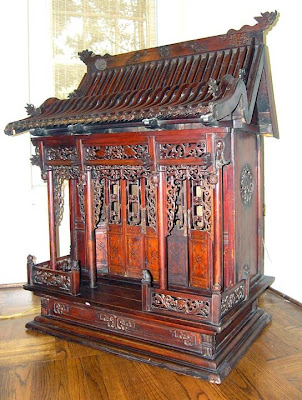
Our Daoist shrine in the San Antonio Museum of Art

During our five-year China sourjoun in the 1990s, we were able to acquire many delightful treasures, both new and antique. When we lived in south China we made a trip to Beijing and bought what turned out to be a rather fine ancestral shrine or tablet house. The age is not certain; professional estimates have ranged from Ming dynasty (mid 17th century) to late Qing dynasty (early 19th century). This example is particularly scarce in that it is twice the size of most commonly-seen domestic shrines.


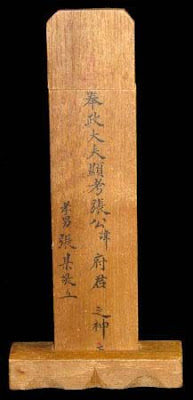
Ancestor worship, which is found in many forms in cultures throughout the world, has long been a key religious belief and practice in China. Chinese religion, with its blend of Confucianism, Taoism, and Buddhism, involves a wide variety of practices and associated paraphernalia. Spirit tablets are one type of ritual object commonly seen in temples and shrines and on household altars. The tablets are inscribed with the title and name of the deceased, dates of birth and death, and additional information such as place of burial and the name of the son who erects the tablet. Incense is lit before the tablets daily and offerings of food are made twice a month.
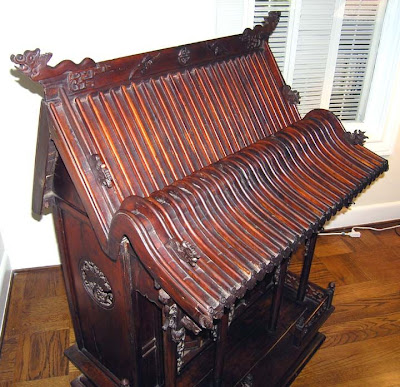
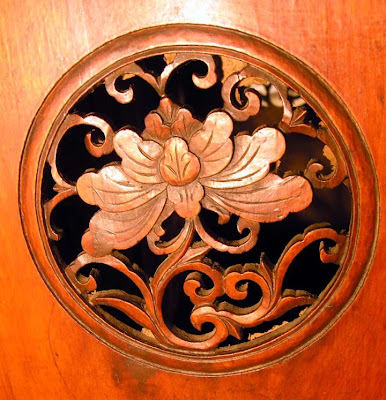


Families would keep a shrine such as this one in their house to contain the tablets on which would be inscribed the names of these ancestors, all of whom were revered and held in the highest esteem. This is an example of such a tablet:


The size and splendour of this particular example suggests that its original owner was most likely of some wealth and stature, possibly a government bureaucrat. The dragon finials on the ends of the roof copings support this theory.


During the Cultural Revolution in Maoist China, their use on the mainland diminished but shrines in use can still be seen in other parts of Asia where there are significant Chinese populations such as Taiwan, Singapore and Malaysia. This one is from Singapore:
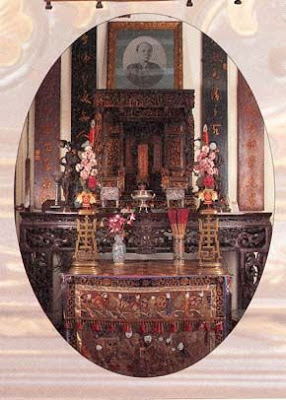


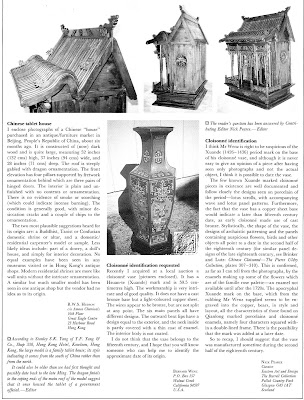
Our shrine was featured in the April 1994 edition of "Arts of Asia" magazine. Dr. Craig Clunas, Senior Research Fellow in Chinese Studies at the Victoria and Albert Museum in London confirmed the identification as a domestic shrine and suggested a date of mid-18th to early-19th century. Mr. Stanley Yang of Y.F. Yang and Co. (Hong Kong) suggested a date as early as Ming dynasty (which ended in the mid-17th century).


When we actually moved to Beijing, the shrine was crated up and shipped to Houston where it went into storage. After eight or so years in San Antonio, it was time to move and the shrine was offered to the San Antonio Museum of Art who gratefully accepted it.


We assume it has now found its final home where it can be admired by many.

Homecoming of a New Zealand treasure

Once upon a time, a rather nerdy teenager had a museum at his house. At his age, he should have been out chasing girls but instead, he spent most of his leisure hours curating his eclectic collection of “stuff”. Indeed several local newspaper articles featured our young, illustrious hero.


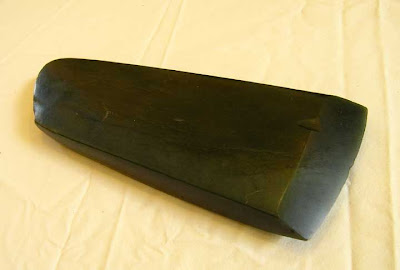
Several of his exhibits came from his father, a famous geologist and head of a university geology department. One of these items was an “axe” that supposedly came from Australia and was beautifully fashioned in a green mineral. So clean were its lines that it wasn’t clear that the “axe” was not machine- made and therefore a fake or a hoax.


Almost fifty years later, our museum curator, now retired from a career in the oil business, decided to downsize his possessions and this process meant getting rid of a few of the last-remaining exhibits from his original collection. This included the “axe” and it was listed on eBay, making sure that a clear description was given, together with the doubts over its authenticity.

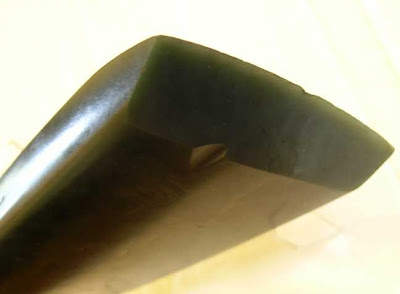
One prospective bidder sent many detailed questions concerning the “axe” and he ended up as the winner of the on-line auction. And then things got really exciting. Since its original creation, the “axe” had a most remarkable journey and ended up back in its country of origin, New Zealand. The Te Papa (the NZ national museum) confirmed the eBay buyer’s hunch that it was an original and very fine Maori toki or adze. It was made from nephrite (a type of jade) and was probably ceremonial and of some antiquity.
Once it returned to New Zealand it became protected from export, being classified as a Toanga Tuturu or national cultural treasure. The buyer was a private collector, though registered with the government and allowed to legally own such items. He truly believes that we never actually own such things but are merely their custodians as they will far outlast us and the adze will eventually be donated to Te Papa. This is its certificate confirming its origin and its status as a national treasure.


The photos that had been included in the eBay listing apparently showed a unique characteristic not usually found in modern reproductions. Also, the silky, satin-like surface texture is only found on hand ground tools. The adze is in remarkably good condition with a very sharp fine cutting edge. The Maori were the finest wood carvers in Polynesia and their tools reflect that.


On the adze’s journey across the world, one can only speculate. The Victorians were great collectors of cultural items from the "Empire" and many fine Maori pieces are still in Europe. The eBay price realised was a few hundred UD dollars but the monetary worth of the adze, if sold at conventional auction, would be measured in thousands, rather than hundreds of dollars. But that is not the point. The adze has indeed returned to its literal and spiritual home and that, without doubt, is a truly delightful outcome.

Tuesday, August 19, 2008

The real estate market in Austin

And so checking out the real estate market in Austin has begun. We have done at least a "drive-by" on about 50 houses so far. Of course there is a fair amount of sticker shock as we had expected but there are oodles of properties on the market so one might hope that this will eventually result in a softening of prices. Our house on Canterbury Hill was on 1/3 acre and sold for about $240/sq ft. which at least gives us a point of reference. You can see it at:

http://www.phyllisbrowning.com/content/PropertyDetail.aspx?TABLE=mdbCondos&PB=Y&ID=9565

In Austin, the houses we have looked at range from about 230 – 380/sq ft, depending on location and lot size. We also checked out a few condos that ranged from about $200 - $300/sq ft. Lot sizes are typically small (about 0.2 acres or less) tho’ further out they are more likely to be 1/3 – ½ acre.

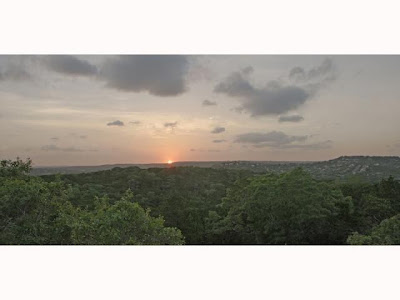
Given the topography with its multiple canyons, views represent a selling point. Either the Hill Country ....


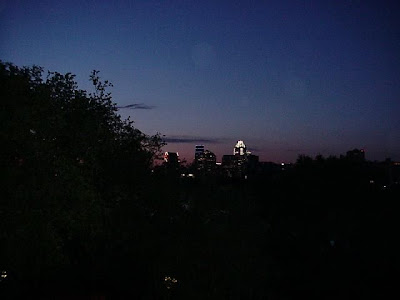
or the city ......

!!!!

Of course, as always, we like the “older” (20s/30s) houses ......


but the reality is that most are in neighbourhoods that are way out of our price range.

Even the older “cottages” in desirable areas ......


come pretty pricey, especially if the renovation is high quality .....

.

We have also seen a few new-retro houses that we like .......


and some seem to be built to relatively high standards.

As you get further out, the available square footage goes up as does the lot size. Limestone exteriors seem popular tho’ this one clearly needs repainting in a colour that compliments the stone rather than tries to match it ......

.

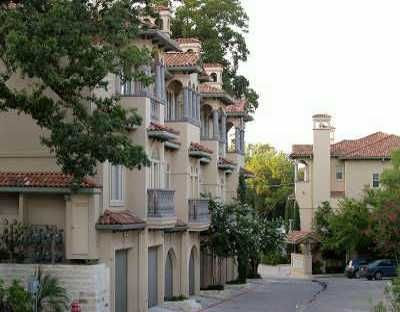
We have looked at a few condos. Most are in the 1700-2300 sq ft range. This one was right in town, off Barton Springs Road .....


but the issue usually is one of floor plan …. just not enough rooms for two retirees who spend much of the day in the house.

We have pretty much decided that the best balance of price/house seems to be in MLS areas 1B, 4, 6, 7, & the southern part of 8.


That’s Highland Hills-Balcones Park in the NW, Rosedale-Allandale to the north, Travis Heights/Barton Heights/Barton Hills to the south and Rollingwood to the southwest.

That’s still a lot to choose from and there is the rest of the USA to consider yet.

Tuesday, July 22, 2008

Peru - the Rest of the Story

So here are a few photo-highlights from Peru …. it was so very difficult to select 40-odd pictures from the several hundred that we have but this will give you a flavour of some of the things we experienced .......

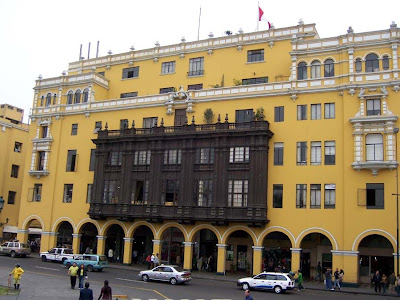
Lima itself (population approx. 10 million) has a UNESCO World Heritage site downtown …… tho’ it is an oasis in a rather bleak and run-down city


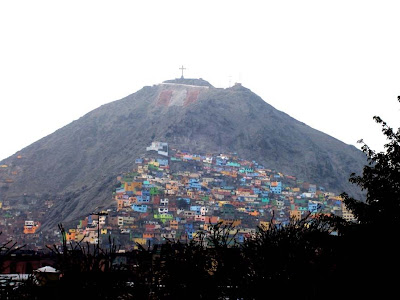
….. and the shanty towns are ever-growing ….. this one seems to be climbing a mountain


Cuzco was definitely our preferred hang-out spot with a great central square


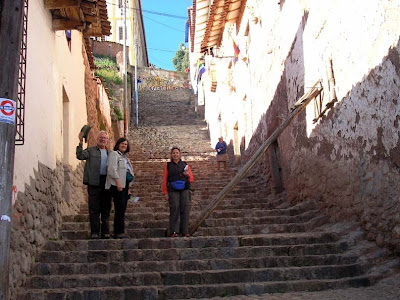
And plenty of neat alleys to explore


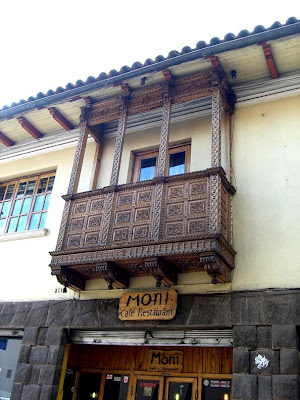
Even modest villages had some fine buildings


And the Moorish influence was self-evident


My theory that Fatimah’s Hand door knockers define the limits of Moorish architecture held up quite nicely


Agriculture was often quite retro ….. here ploughing with oxen


And here winnowing the chaff


Markets were predictably colourful


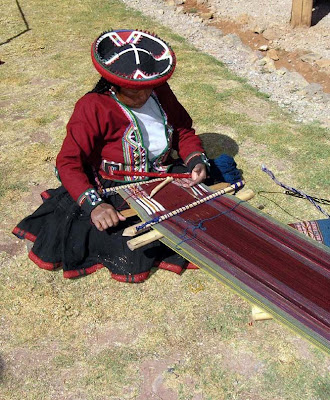
Rural Indian women often practiced weaving


While the men crocheted


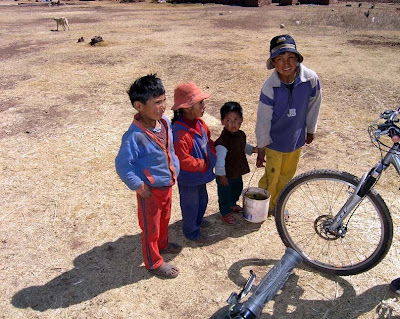
Children often have hard lives


But a smile is always round the corner


And our activities always produced shy curiosity


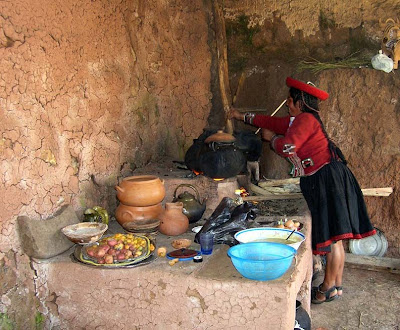
Food was uniformly good, except perhaps, Mike’s fried guinea pig tho’ he said it tasted “just like squirrel” – as if I would know.


Amazing what you could find !!!!


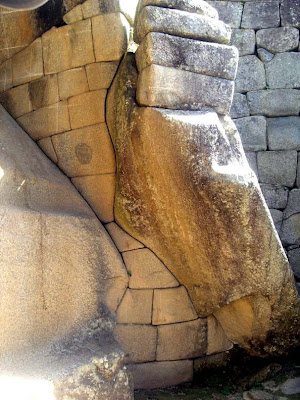
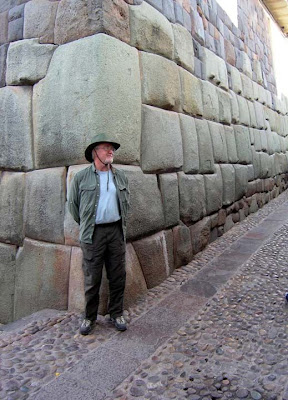
Switching now to the Incas themselves. Of course their masonry skills are legendary … how they fitted huge diorite building stones together is quite remarkable, shown here with Dave doing his best to look Inca-like


And even the natural curve of outcropping rock was accomodated ..


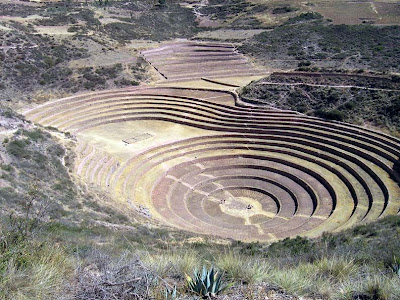
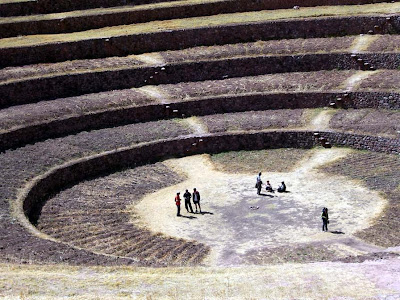
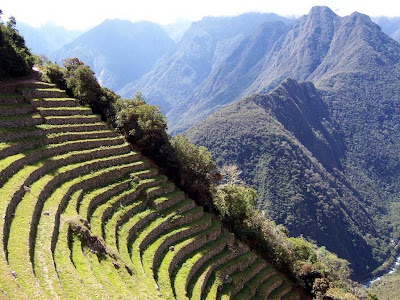
And the huge experimental terraced greenhouse in Moray was also unique. To get an idea of size, look at the tiny humans in the centre of the complex


And here they are ....


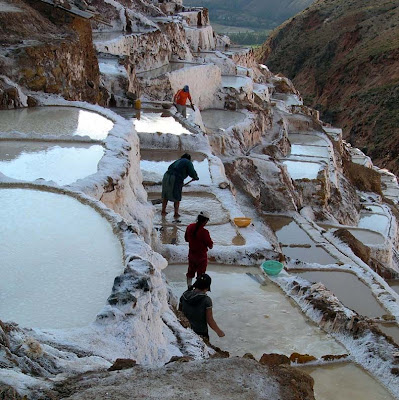
Even more curious were the salinas, fed by naturally occurring salt-rich streams


That are fed into terraced pools where the water evaporates


Leaving the salt to be ‘mined”


And then transported to the customers


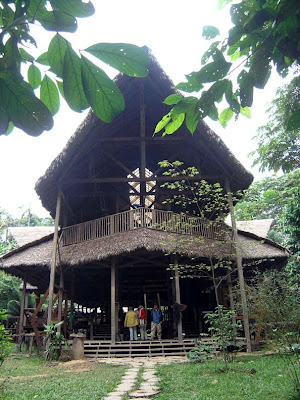
The first leg of the trip was to the rain forest where the new lodge proved to be no hardship whatsoever


Here, Becky examines the “walking palm” which can move 80 cm per year


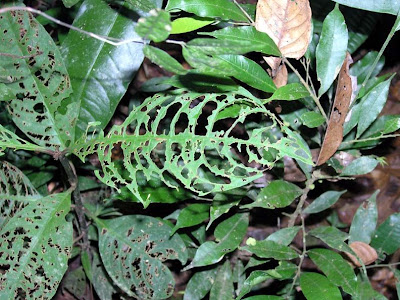
While the leaf-cutter ants chomp away


And then cart of the prize to their underground compost heaps


Of course much of the vegetation was spectacular, especially the orchids


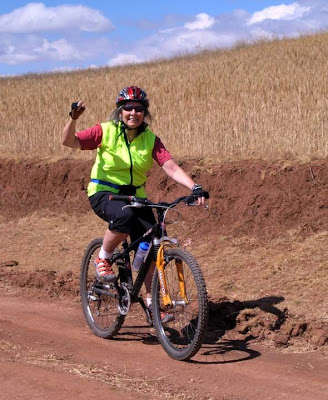
Phase two was the mountain biking


All the terrain was so arid …. the only snow was on the very high peaks in the distance


Easy to start with …


But then the last third was all downhill with narrow trails, hairpin bends, clouds of dust and plenty of pretty big rocks to circumnavigate


Next came the Inca Trail


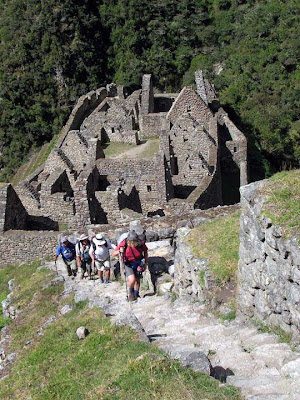
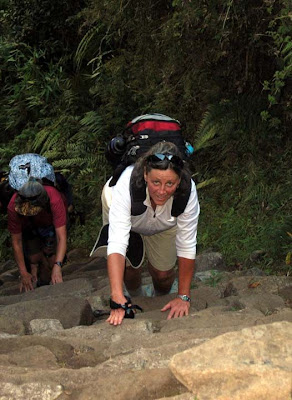
Oh so steep


Though the afternoon was in semi-tropical jungle


But still so much climbing


And yet more steps


But all worthwhile in the end. This shot of Machu Picchu has to be one of the most photographed views in the world.


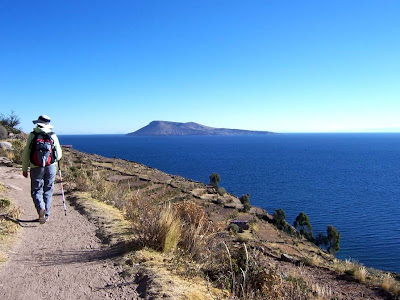
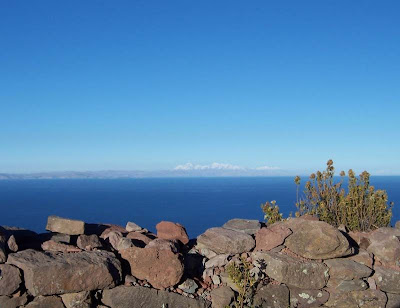
For me, the highlight of the whole trip was probably Lake Titicaca. Sorry, Machu Picchu – is that heresy? But it is so very blue


With the Bolivian Andes in the distance


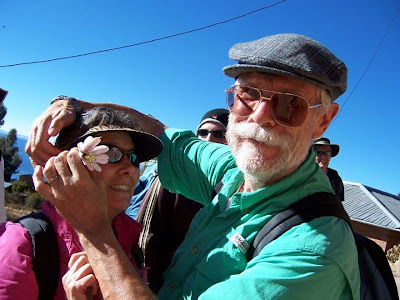
Being our anniversary, Sharon got a symbolic flower behind her ear


Accommodation was quite delightful with extraordinarily gracious families


And I was introduced to the mean-spirited Pepe


But fortunately, Maggie decided not to bring her own new-found friend back to the US


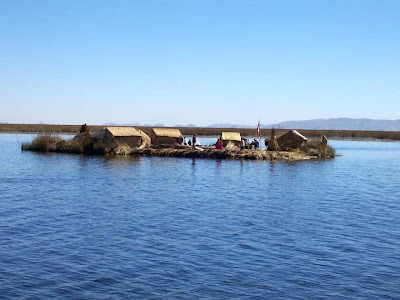
The Uro Aymara floating villages were very special


Everything was made of reeds; not only the islands themselves but also the houses ……..


……… and the boats


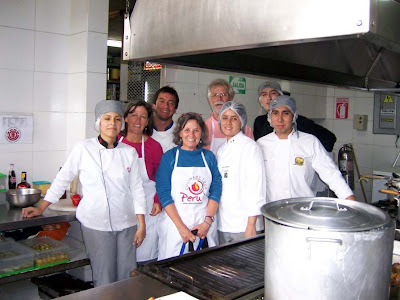
Finally back to Lima for the culinary tour which included a lesson on how to make Peruvian cerviche.


And for now, good-bye and good luck ......