Monday, February 7, 2011

Halcyon Days In Egypt

In some ways I think of  Egypt as my third home.  Now we must hope for a peaceful and positive outcome to the recent harrowing days of protest.

Many visitors to Cairo are at first overwhelmed with the noise, the dust, the traffic.  But behind this powerful veneer lies a splendid, functioning, medieval city. This photo captures some key elements of Cairo ..... a mosque in the foreground, felukkas on the Nile and the Pyramids of Giza faintly seen though the red, dusty air.


The River and the Delta form such a tiny percentage of the total area of Egypt; most is arid desert. In the distance, you can see the sharp delineation between sand and the fertile agricultural land.


It is a grand people-watching location, mainly folks just going about their business. The knife grinder, the yam seller, the potter with his kilns and the fellahin.


The children ........


A man having a quite smoke ....... and inevitably the less fortunate .....


Of course friends were essential components of my life.  Both Egyptian (Salah Zafaan and me)


and those special expatriate friends who were almost in loco parentis to me as a single young man.


And I suppose we should not forget that, after all, our business reason for being there was to find oil, in partnership with our Egyptian colleagues.


Egypt:  I think about you nearly every day in these troubling times.

Friday, February 4, 2011

Foreign Model Worker & Zhu Rongii

A brief moment of "fame" (?) was in 1996 when I was declared ..........


The ceremony and State Banquet at the Great Hall of the People was hosted by (then) vice-premier Zhu Rongji, later the Premier, of The Peoples' Republic.  http://en.wikipedia.org/wiki/Zhu_Rongji 

This is how the China Daily saw it.


Note that I was thanked for my contribution to the Victory of the Chinese Revolution..... wow !!!


I guess we have now both moved on ......

Michigan says "What's the Big Deal"


OK, OK, so it was only an inch or so. But is is REAL SNOW and here in Central Texas.


But I get ahead of myself. First I have to dress appropriately:


Now we are ready to go. The back yard:


Shoal Creek:


And the Boulevard in the middle of rush hour (8 pm on a Friday).


So take that, Michigan !!!!


Sunday, January 30, 2011

Bernard's act of kindness

This delightful tale is courtesy of Bernard Mollberg who was the savior of the little bushy-tailed hero.

I was walking by one of our rain downspouts and I heard a noise. Kind of a scuttering, and scratching kind of sound. Then I heard splashing ...... and more scratching ..... more splashing (our downspouts connect to PVC pipe which carries water to our cistern and always have some water at the bottom).

I removed the metal downspout that connects to the pipe .... and …… got a dog leash, and lowered it down the pipe. But no sound and the leash wasn't long enough to reach the water.

So I got a second dog leash, clipped it to the first one and lowered again. I slowly lowered it down. Felt some movement & slowly pulled up the leash.

Felt some weight .... then: nothing. Lowered it again. Felt the weight on the leash again. Slowly pulled up the leash.

Slowly, slowly, higher and higher and at last from the top of the pipe I see:

A SQUIRREL IN THE DOWNSPOUT !!!!!!!

He was pretty weak. Been soaking in 40˚ water, maybe a pretty long time. He seemed unsure of my intentions.

Finally got him over the edge.... he almost fell back down once.

Dry land at last. Finally I give him a nudge with a broom handle, and off he goes.

I've now got a great name for a new fiddle tune.

All I have to do now is write one.

Friday, January 28, 2011

The Rhino House

Whether by day …..

Or by night …….

You can understand why some children in the neighborhood think of our’s as the Rhino House.

Tuesday, November 16, 2010

A Healthy Obsession


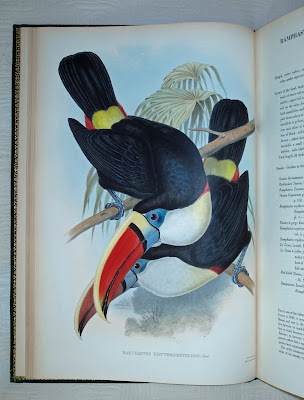
I admit to being mildly obsessed with bicycles. I have a friend who is (or at least was) mildly obsessed with toucans. He once owned them, studied them, read about them and collected books about them. However it was now time for him to downsize and I willingly accepted his invitation to help sell a treatise of his, entitled Monograph of the Ramphastidae by John Gould. It quickly became apparent that this was not your usual eBay item and before long, I embarked on a sleuth’s trail to establish the book’s true value and to determine how best to sell it.

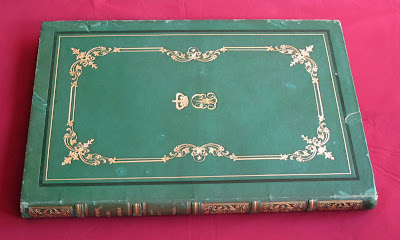
The value of this particular volume was hopefully enhanced by its provenance: it had been purchased by, or for, Philippe, Count of Flanders (1837 – 1905), 2nd son of Leopold I of Belgium. The Count's Royal monogram was on the cover.

I talked to both Sotheby’s and Christies in New York, several dealers on the East Coast and Henry Sotheran in London. The latter dealer had purchased most of Gould’s residual inventory and lithographic plates etc. following his death in 1881 and is unquestionably the world’s leading authority on him. Although very valuable, the book was not of a rarity that would justify shipping it to London and, taking Sotheran’s advice, I then contacted Donald Heald in New York.

Heald is a specialist in 19th century natural history lithographs. Based on what little pricing data I could find, I made the assumption that the “retail” value of the book was about $60,000. Given that an informed bidder would discount the book by the 25% buyer’s premium at auction and then taking the 11.5% seller’s premium/handling into account, that would result in net proceeds of about $39,800, assuming it sold as expected. It seemed to make sense to give Heald first “kick at the can”. Once I had convinced a reluctant UPS to accept the book for overnight delivery to New York, Donald Heald was able to make a cash offer of $40, 000 which I thought was fair. My friend duly accepted the offer and the cash was wire-transferred to his account within 24 hours. Mission accomplished.

A brief encounter with a civil war

After Sharon & I got married, our first overseas assignment together was to Mogadishu. At that time (1987), the Somali capital was a sleepy Arab-African port city on the ancient trade routes from Zanzibar to India via Kenya and Aden. It was a safe city, we had a pretty splendid house (less splendid when we had no water and/or electricity) and we were able to make friends fairly quickly.
The first sign of trouble for us was in 1988 with the bombing of the Isaaq population in the northern city of Hargeisa by South African & ex-Rhodesian mercenary pilots on President Siad Barre’s payroll. These air attacks claimed tens of thousands of casualties. Although there had been some trouble in Mogadishu when, in July 1989, the Italian Bishop Pietro Salvatore Colombo, had been killed, we assumed that Barre had things under control in the capital.
Later that month, Sharon was invited to a Somali wedding and I took a newly-transferred expat administrator and his wife to lunch at a beach restaurant in the city. One of the waiters mysteriously said that we should lay low that afternoon but I had no idea what he meant. Driving back to the Amoco staff house, we ran into a huge crowd of exited Somalis running towards us.  It soon became clear why. They were fleeing “technicals” (small trucks with mounted machine guns) that were indiscriminately firing on them. Amazingly, some Somalis took the time to stop and pick up rocks with which to stone our vehicle and that only added to the chaos. Deciding that this was no place to be, I spun the Landcruiser around, headed for ”bush” and then made a wide detour back to the staff house. Only hours ago I had been telling the new expats what a safe place Mogadishu was and so when I yelled at them to get down flat on the on the Landcruiser floor, my credibility suffered somewhat.
I found out later that Sharon had gone to meet some of her friends and co-workers at USAID before going to the wedding but once the gunfire started, the US Marines forbid any of the Embassy staff to leave the compound where they were relatively safe. It was the next day before she was escorted back to our staff house. Phone service in Mogadishu was always pitiful and so the Embassy allowed her to bring a VHF radio with her to allow us to keep in touch with State Department staff.
I managed to coral all Amoco personnel at the staff house and we implemented a Company curfew that was one hour “tighter” than the official one that was imposed in the mornings and evenings in response to the rioting by the Hawiye clan. It later transpired that hundreds had been killed in the protests. 
It was a surreal time for us. Gun and mortar-fire all around, a finite amount of food and minimal communication with the outside world and no knowing what the outcome of this crisis would be. Across the street we saw another foreigner's house being looted and I knew that we had no real protection in our own staff house. Neither the walls nor the “guards” would offer any protection if it came to the crunch. As it turned out the residents of the looted house were inside at the time, hiding in wardrobes. They later managed to get across to the street to us where I reluctantly offered them refuge. Reluctant because they were actually missionary workers purporting to be teachers; that is why their house had been targeted. Would the same thing now happen to us?
Siad Barre cracked down hard on the Hawiye dissidents in Mogadishu with dozens of extrajudicial executions on Jezeira Beach. For the next few months, things quieted down but still with odd outbursts of unrest and violence although we were able to return to our own houses. Ironically and somewhat surprisingly, I do not recall being really “scared” during the tumult although we certainly should have been. Before too long my own transfer to Denver was announced and we did manage to ship our belongings out of the country. With the help of a “facilitator”, we eventually got permission from the teetering Government to bring in the Amoco plane from Kenya. It quietly slipped in before dawn one morning and we left just as the sun was rising.  An Amoco administrator in Nairobi had gone over to the pilots’ house the night before with champagne and chocolate-covered strawberries. It made an oddly surreal breakfast as the small plane climbed away from the doomed city and we left Somalia behind forever. Not too long thereafter, the country collapsed into total anarchy from which it has never recovered.

Friday, November 12, 2010

David Hockney and Me

Back in the “Days of Noah” (mid-60s) I used to hitch-hike up and down the M1 from university to my mother’s house in Yorkshire. Generally a safe and uneventful mode of transport, usually aided by the wearing of a college scarf to reassure drivers that I was harmless. I have various memories of these days but the one that I like to share is as follows. I was picked up by a guy in a fairly non-descript car that turned out to be a rental. Making conversation was part of the “deal”; it was a reasonable assumption that most drivers wanted company. The driver looked vaguely familiar but it was only after he told me that he lived in the USA and was an artist that I recognized David Hockney.

He was also on his way to see his mum ..… in near-by Bingley and he was gracious enough to drive me all the way to Riddlesden.

Coincidentally, he and I had gone to the same grammar school (at different times) though he had left at the earliest opportunity and transferred first to to Bradford College of Art and then to the Royal School of Art in London. He did remember “Jock” Gross, an English teacher who was perhaps the only member of staff at school who truly appreciated Hockney's genius.

There was at one time a large oil of Hockney’s on a school classroom wall. I assume it is now in a safer place. One of his paintings fetched almost $8 million in 2009. What a pity I did not finagle a signed sketch from him.

La Crema is what it takes: true espresso


There are, in my opinion, precious few coffee shops in Austin that truly know how to make espresso drinks.

One common denominator between those that do, is that they all use “La Marzocco”machines. The company was founded by Giuseppe Bambi in 1927 and with their professional machines costing around $12000, they are not for the fiscally faint-hearted.

For the consumer, one critical characteristic that distinguishes “OK” from “Exceptional” espresso is the Crema. It is part of the visual allure of espresso, the aromatics, the mouth-feel, the flavor and long-lasting aftertaste of espresso. In its technical definition, crema is gas bubbles suspended in a liquid film that has high surface tension between the water molecules. Crema should be compact and persistent: it should last a full two minutes before the suspended water molecules drain, the entrapped gas is released and the liquid underneath shows through.

Sadly, nearly all coffee shops offer just froth which is a pathetic imitation of the true product.

And the winners are:

Café Medici (1101 West Lynn & 2222 B Guadalupe St)

JP's Java (2803 San Jacinto Blvd.)

Once Over Coffee (2009 South First Street).

Tuesday, November 2, 2010

Its rather sad that so many wonderful children’s’ books do not appear to have survived from one generation to another. Of course there are endless examples of those that do: Peter Rabbit, Pooh, Wind in the Willows, all the Edith Nesbit titles, Frances Hodgson Burnett (very yuky though the Secret Garden was OK; set in Yorkshire, of course), Tolkein and Noel Streatfield.

Some, such as Rupert, Swallows and Amazons, Little Grey Rabbit and the Just William series seem to be kept alive only by those who were childhood afficandos years ago. Other titles were shamed into oblivion such as Epaminondas, Little Black Sambo and most of the Enid Blyton material (though the latter seems to have remarkable resilience).
But what about the others? I was lucky: I grew up in a home with three siblings and all of us were encouraged to read, read, read. From my elder brother’s books I was able to enjoy My Friend Mr. Leakey, The Log of the Ark and Golden Island.

All minor classics in their time but now most likely out-of-print.

My favorite from my sister’s titles was the Family from One-End Street which does seem to be a survivor though heavily criticized for its class stereo-typing.

From my own childhood there are Ditta’s Tree, the Meeting Pool and Roger Lancelyn Green’s retelling of the ancient classics. Now long disappeared from most bookshelves. My younger brother added Stig of the Dump, also a survivor, to my inventory.

“Children Catching Criminals” seems to be a favorite theme that transcended all our generations: Emil & the Detectives (1929), the very similar Otterbury Incident (1948) and A Hundred Million Francs (1958) all tell essentially the same tale and these three seem to be still around.

And what of the more recent material? Will Harry Potter be around fifty years from now?