Tuesday, July 22, 2008

Peru - the Rest of the Story

So here are a few photo-highlights from Peru …. it was so very difficult to select 40-odd pictures from the several hundred that we have but this will give you a flavour of some of the things we experienced .......

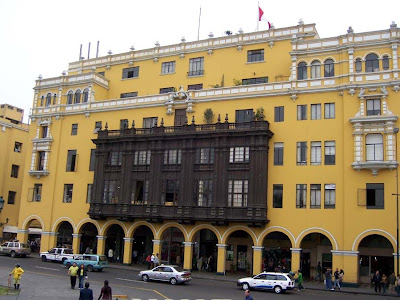
Lima itself (population approx. 10 million) has a UNESCO World Heritage site downtown …… tho’ it is an oasis in a rather bleak and run-down city


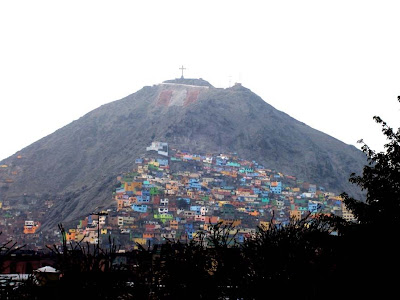
….. and the shanty towns are ever-growing ….. this one seems to be climbing a mountain


Cuzco was definitely our preferred hang-out spot with a great central square


And plenty of neat alleys to explore
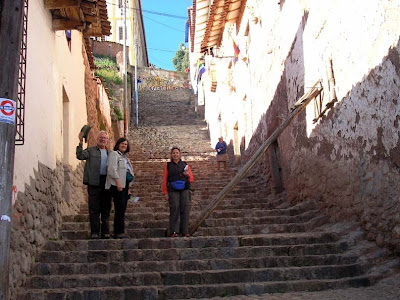


Even modest villages had some fine buildings


And the Moorish influence was self-evident
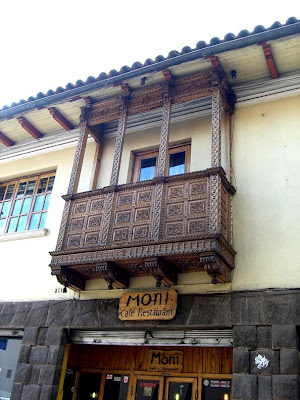


My theory that Fatimah’s Hand door knockers define the limits of Moorish architecture held up quite nicely


Agriculture was often quite retro ….. here ploughing with oxen


And here winnowing the chaff


Markets were predictably colourful


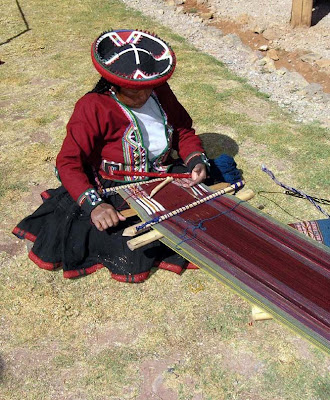
Rural Indian women often practiced weaving
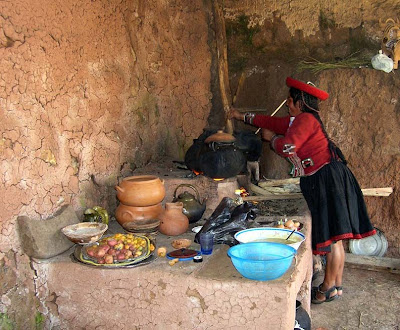


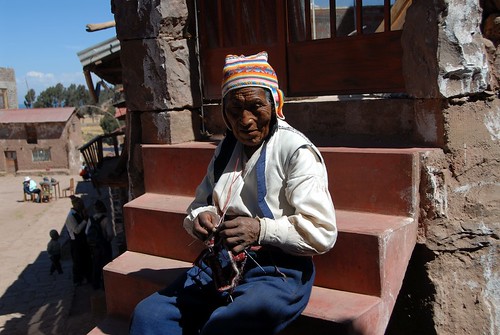
While the men crocheted


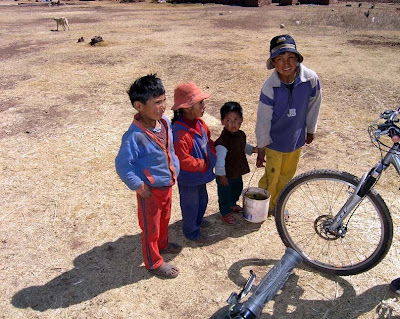
Children often have hard lives


But a smile is always round the corner
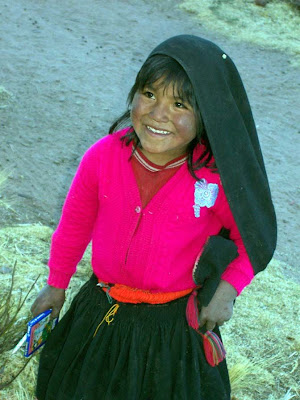


And our activities always produced shy curiosity


Food was uniformly good, except perhaps, Mike’s fried guinea pig tho’ he said it tasted “just like squirrel” – as if I would know.


Amazing what you could find !!!!


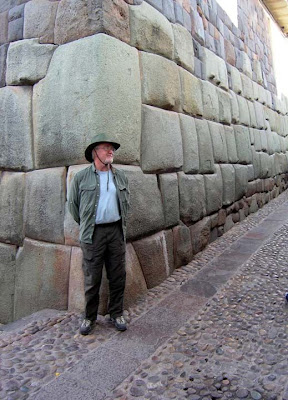
Switching now to the Incas themselves. Of course their masonry skills are legendary … how they fitted huge diorite building stones together is quite remarkable, shown here with Dave doing his best to look Inca-like


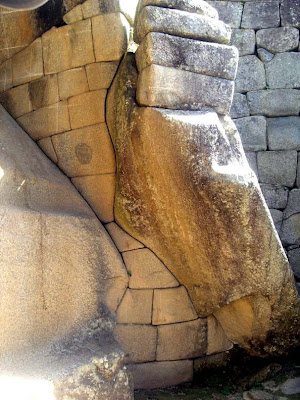
And even the natural curve of outcropping rock was accomodated ..


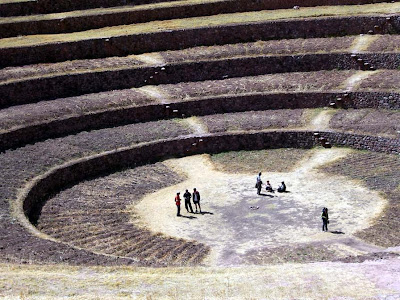
And the huge experimental terraced greenhouse in Moray was also unique. To get an idea of size, look at the tiny humans in the centre of the complex
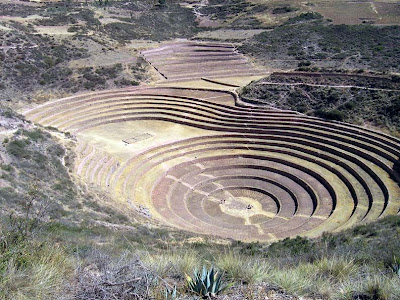


And here they are ....


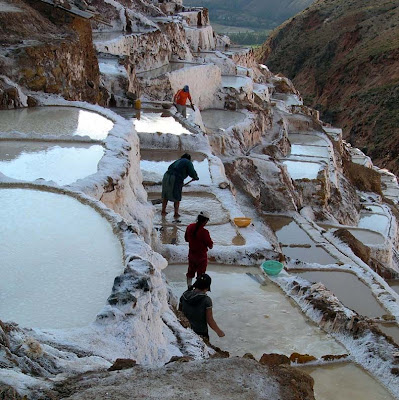
Even more curious were the salinas, fed by naturally occurring salt-rich streams


That are fed into terraced pools where the water evaporates


Leaving the salt to be ‘mined”


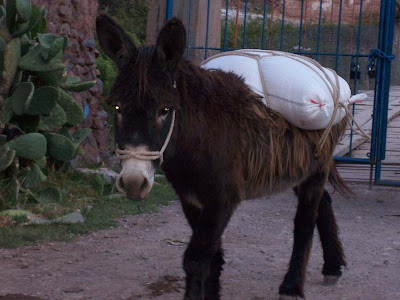
And then transported to the customers


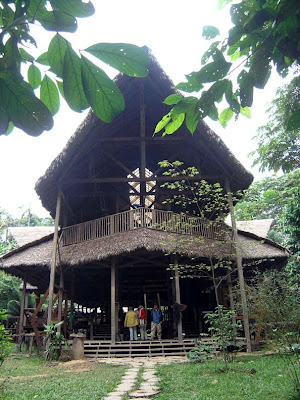
The first leg of the trip was to the rain forest where the new lodge proved to be no hardship whatsoever


Here, Becky examines the “walking palm” which can move 80 cm per year


While the leaf-cutter ants chomp away
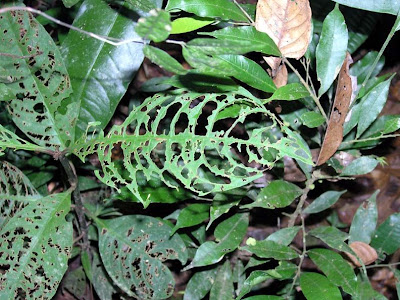


And then cart of the prize to their underground compost heaps


Of course much of the vegetation was spectacular, especially the orchids


Phase two was the mountain biking


All the terrain was so arid …. the only snow was on the very high peaks in the distance


Easy to start with …
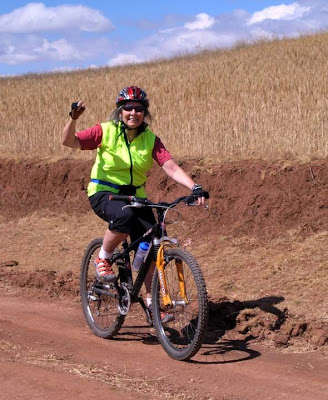


But then the last third was all downhill with narrow trails, hairpin bends, clouds of dust and plenty of pretty big rocks to circumnavigate


Next came the Inca Trail


Oh so steep
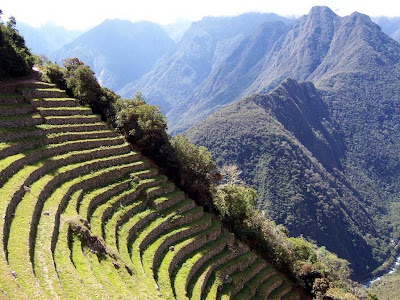


Though the afternoon was in semi-tropical jungle


But still so much climbing
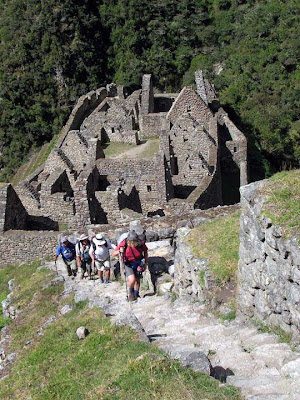


And yet more steps
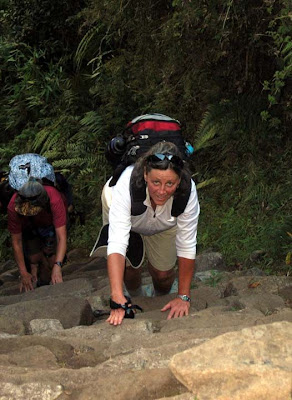


But all worthwhile in the end. This shot of Machu Picchu has to be one of the most photographed views in the world.


For me, the highlight of the whole trip was probably Lake Titicaca. Sorry, Machu Picchu – is that heresy? But it is so very blue
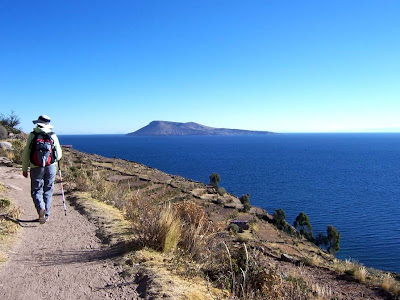


With the Bolivian Andes in the distance
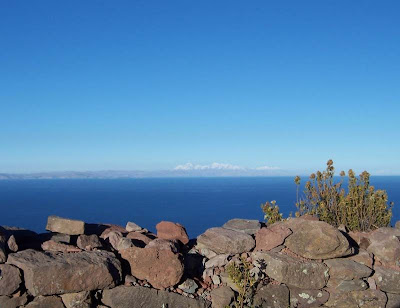


Being our anniversary, Sharon got a symbolic flower behind her ear
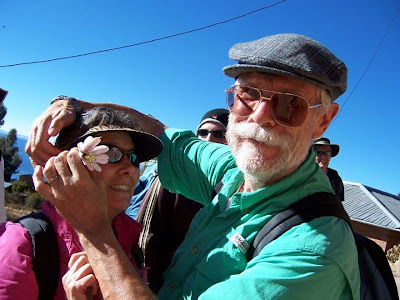


Accommodation was quite delightful with extraordinarily gracious families


And I was introduced to the mean-spirited Pepe


But fortunately, Maggie decided not to bring her own new-found friend back to the US


The Uro Aymara floating villages were very special
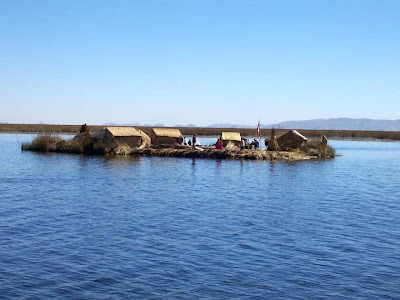


Everything was made of reeds; not only the islands themselves but also the houses ……..


……… and the boats


Finally back to Lima for the culinary tour which included a lesson on how to make Peruvian cerviche.
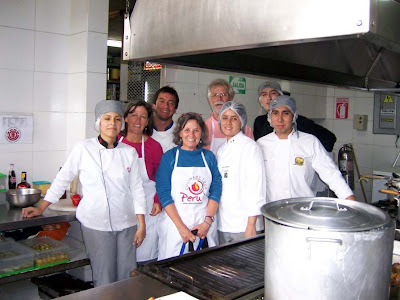


And for now, good-bye and good luck ......

Thursday, July 10, 2008

Last blog from Peru

This is the last blog from Peru, assuming our flight tonight goes out OK. Yesterday we did what we thought was an overtly touristy thing by going on a culinary tour of Lima. In fact it was relatively serious and we did learn a lot as well as eat more than we should. Mike was rather sick beforehand and so missed it. Great shame as he would have loved investigating those huge fish in the market.

True to form, there was a general strike today and we were discouraged from going to the central area that we had planned to do. However, things quietened down around midday so we did take a tourist bus tour that was only OK but otherwise we would have left without seeing Central Lima. It was sobering seeing all the riot troops out with shields and water cannon. Apparently, yesterday there were outbreaks of violence in two areas we were in last week.

Old Lima is a UNESCO world heritage site but is, not surprisingly, in serious need of preservation. It shares some characteristics of Cairo in being extraordinarily dirty, noisy and polluted but underneath is a very beautiful place. There was a strong Moorish influence on the old colonial architecture and my pet theory about the distribution of Fatima´s Hand door knockers appears to be holding up rather well. I was very impressed with the 16th century convent and Mike & Maggie were intrigued by the thousands of bones in the catacombs.

Tuesday, July 8, 2008

Lake Titicaca adventures

And so we have now returned to Lima after our Lake Titicaca adventures. The nine-hour bus trip up from Cuzco to Puno was somewhat uneventful though we did stop at some colonial villages and pre-Inca sites that many visitors do not usually get to see. The only other entertainment for our fellow passengers was me getting stuck in the bus loo and banging on the door to be rescued.

Just as Pagan is, for me, one of the most magical of all man-made “wonders”, so Lake Titicaca is now on my top list of natural creations. The huge expanse of blue water set against the snow-covered Bolivian Andes is truly breath taking, if you will forgive the platitude.

Our 21st wedding anniversary was spent on the first day of kayaking and so matrimonial chivalry demanded that Sharon & I took a tandem kayak. The paddling exercise itself was only OK (fast river kayaking beats sea or lake kayaking any day in my opinion) but the setting was clearly unbeatable. At the end of the first day we felt that we had had enough exercise but the following morning, we were ready for more.

Our first home-stay was on the Llachon peninsula. The island where we spent the second night at was Amantani http://upload.wikimedia.org/wikipedia/commons/thumb/e/eb/Intikawan_Amantani.jpg/800px-Intikawan_Amantani.jpg and the third night was on Taquile http://www.comollegarperu.com/segundaparte/fotosgrandsur/Isla%20Taquile%20-%20Puno.jpg

The Quechua or Aymara families with whom we stayed were so gentle and gracious and had a wonderful sense of humor. They still practice their fishing and farming, practice a working system of community socialism and wear traditional dress. They are relatively untouched by overt tourism though it is inevitably becoming an important source of income. http://www.prato.linux.it/~lmasetti/antiwarsongs/img/upl/quechua.jpg and http://farm1.static.flickr.com/148/383488327_943b69acd1.jpg?v=0

The home-stays way exceeded our expectations. We had heard or read stories of visitors getting horrendously sick, of earthen floors, no plumbing whatsoever etc. While there was indeed no electricity in some communities and certainly no hot water, all the places we stayed were quite delightful and the food provided was always delicious. Of course the lack of electricity offered stargazing that was unparalleled. It really is odd that so many people in the developed world have never actually seen the Milky Way in its true glory.

On the last day we were privileged to visit one of the remote reed floating islands. There are several dozen and the bigger ones near Puno have been turned into shameful Disney-like travesties. We went to a small, very distant island that was very special. The Uros families moved offshore as far back as the 12th century to escape mainland marauders and live on islands constructed of reeds that have reed houses on them and are serviced by reed boats. http://www.jonasspillmann.ch/gallery/peru/uros.jpg and http://imagecache2.allposters.com/images/pic/SSPOD/SuperStock_1269-605~Reed-Boat-Uros-Islands-Lake-Titicaca-Peru-Posters.jpg Of course you will immediately be struck by the hypocrisy of what I have just written. Our own visit no doubt contributed one more small step towards the remote islands following the sad fate of their larger cousins.

I again, sadly, provided the last entertainment for the group. As I was tempting Pepe, a supposedly friendly Alpaca (close cousin of the llama) with a corn stalk, he turned to me with a contemptuous expression, gave one horrendous snort and blew the chewed-up contents of his mouth all over my face. I had forgotten that the llama family is also distantly related to the camels so I should have known better.

We left early this morning for the flight to Lima; braving stone road blocks in the road to the airport created by today’s Puno strikers. Tomorrow is a general strike across the country so I am not sure how we will be affected. Other than our culinary tour tomorrow (if it happens), this trip is drawing to its close. It’s the first so-called “adventure” tour that we have done and we certainly enjoyed the diversity of activities, the rain forest expeditions, the mountain biking, the Inca trail hike and the kayaking. I suppose while we are still relatively young and in good health, it’s a fine way to go.

Dave and Becky made it back to the US and are now in Austin so Dave can get his medical issues sorted out. Sharon had a near-catastrophe yesterday when her banjo got lost ….. she had hauled it all over the Peruvian Andes only to see it disappear on the final leg of the trip. Turned up she had left it on the bus and it was recovered. When we get back, out focus will immediately turn to sorting out the house and moving out so the blog’s activities will take on a very mundane character but might still be a good way for you to follow what’s going on in our lives, if you are so-inclined.

Thursday, July 3, 2008

Next step of our adventure

Tomorrow is the next step of our adventure and the most challenging. Lake Titicaca is very remote, being in Peru but sandwiched between Chile and Bolivia. See www.unesco.org/water/wwap/case_studies/titicaca_lake/img/detailed_titicaca.gif for its location. Picture are at www.worldtravelerjournal.com/wp-content/uploads/LakeTiticaca.jpg and at studentwebs.coloradocollege.edu/~a_lunceford/pm-2%20Lake%20Titicaca.jpg

The first step will be a 9-hour bus journey way up into the Andes that should be pretty spectacular. Titicaca is at 12,507 ft and is the highest navigable lake in the world. There is more info at http://en.wikipedia.org/wiki/Lake_Titicaca Unlikely to be any more blog updates or emails until we get back to Lima in five days or so.

Sadly, Dave and Becky will not be with us as Dave has had a myriad of health problems and they made the wise decision to return to the US tomorrow where he can be treated. Poor Dave did not even get to do the Inca Trail or even see Machu Picchu. They have been great travelling companions and we will really miss them both.

I have thought more about the preservation of Machu Picchu and have decided in my own mind that the Peruvians should “ring fence” the whole complex and only allow access to bone fide archaeologists. Tourists could then view it from designated walkways on the outskirts. They have already done that at many World Heritage sites such as Stonehenge, Mesa Verde etc. etc. Yet another Japanese study says that it will slip away down the mountain anyway at some point in the future.

There is also the issue of all the artifacts that Hiram Bingham (the “American “discoverer”) purloined and sent back to Yale. Of course governments have very stong claims to their national treasures but having seen what happened to the Lagos museum (all the Benin bronzes pilfered) and the Baghdad national museum (admittedly thanks to George W. Bush), I do believe that some collections in seriously protected environments are appropriate.

Wednesday, July 2, 2008

Machu Picchu experience

Today was the Machu Picchu experience. Our guide (Ruben) was a passionate but sincere advocate for Peruvian socialism, environmental protection and a variety of other causes. At first I was not convinced but after a while I decided he was indeed sincere. I am still not 100% sure of all his facts, especially in cases where he was trying to make a political point but at least for some of the time he tried to distinguish between fact and conjecture.

I was interested in the three primary threats to the site. First and not surprising is the physical threat resulting from over-exposure by tourism. I did not realise that there is no limit to the number of tourists per day which often reaches 3000. One university has estimated that the current rate of degradation will totally destroy the site within 75 years or so. This has not been helped by the inane and highly subjective “New Seven Wonders” http://www.new7wonders.com/classic/en/n7w/results/

The second threat is one of land ownership. Apparently one Zabaletas family is claiming ownership through a Spanish land grant and the matter is currently in the courts. Lawyers are representing them on a contigency basis and for the publicity the case is generating. The third threat is the humidity/rainfall that is causing the whole complex to sink. It was, after all, built on a man-made earth infill between two mountains.

Incidentally, we also learned of a woman 19th century mountaineer who climbed some of the highest mountains in South America, including one close to Machu Picchu. See http://www.wingsworldquest.org/cgi-bin/iowa/explorers/record/77.html and
http://en.wikipedia.org/wiki/Annie_Smith_Peck

The risk of an Aguas Calientes strike has diminished. Maybe I did not clarify why a train strike is a big deal here ….. its because there are absolutely no roads in or out of this place …. its either go by train or grow wings. I guess I am over-sensitive to the risk of any significant schduling delays as we have less than a week after our return to empty the house in San Antonio prior to closing on the deal.

Tuesday, July 1, 2008

Major strike in Agua Caliente

The Inca trail hike went very well even tho Sharon kissed the earth a couple of times. It was a seven hour hike and quite strenuous at times but was quite magnificent in the high moutains bordered by shear drops of hundreds (thousands ????) of feet. Machu Picchu has been described ad nauseum by many far more eloquent than I. Here it is anyway …… http://www.fullfondos.com/paisajes/machu_picchu/machu_picchu.jpg Tomorrow we will tour the site in some depth and so further our knowledge of the rise and fall of the Inca kings and nobles.

Plans thereafter are rather uncertain as there will be a major strike here on the day we were supposed to leave for Cuzco. Therefore we shall spend an extra day here that might be rather tedious as the town really has little to offer. ExplorAndes pulled yet another accomodation stunt by insisting on a surcharge for the day of the strike. Very annoying as we do not know if we have any recourse. Anyway, we shall probably take the train a day late and reduce our Titkaka expedition by one day. Still, the French truck drivers do it all the time. I feel sorry for our excellent guide who has to sort out the mess.